– Part 1 –
* Dr J Rimai
The Land
According to the literature review, Manipur was an independent kingdom before the colonization by the British Empire (Singh 2004, 4). However, the extent of the so-called Manipur border is in debate. Some scholars believe that it reached Kabou Valley in Myanmar (Burma) in the east, the Chinese territory in the north, and the Ahom kingdom of Assam in the northwest (Singh 1987, 2-3). This is challenged by the Nagas who inhabit the hills that surround the valley of Manipur. The Nagas say they were never under the rule of the Meitei kings, and that they were an independent nation (Naga Peoples Declaration. 28th June, 2001).
The literature also shows that the name of the present state, Manipur, was given to this land after the declaration of Hinduism as the state religion. It was during the reign of Pamheiba whose Hindu name is Garibniwaz, in the beginning of the eighteenth century (Kumar 2001, 1) that the name ‘Manipur’ came into being. According to Kumar, She (Manipur) had different indigenous names such as Tillikoktong Ahanba in Hayi Chak, Mira Pongthoklam in Haya Chak, Hanna samba konna loiba in Khunung Chak and Muwapali Mayai Sumtongpan in early Konna (Langba) Chak.
In the later ages of Konna (Langba) Chak, it was popularly known as Kanglei Pungmayol, Kangleipak, and Meitreibak. Her other names were Chakpa Langba, then Muwapali, and then Wangang Tengthong Mayung Kuiba Lemthong Maphei Pakpa and, later on she was called Poirei Meitei after the advent of Poireiton. (Kumar 2001, 1-2)
The present Manipur state has many other indigenous names, each indicating its unique meaning. To some, it is known as “Flower on the Lofty Heights” (Singh 2003), and to others it is known as “Kashmir of the Eastern India” (Singh 1980, 1). It is also known as Sana Leipak, which means land of jewels. This is because the land is fertile and rich in its tradition and culture. The other name for Manipur is Kangleipak meaning “Land of the Kang”.[1]
Manipur lies between latitude 23.83° and 25.68° north, and longitude 93.03° and 94.78° east. It has an area of 22,356 square kilometers (Kumar 2004, 5). The central valley, which is made up of only 700 square miles, is inhabited by the Meiteis who make up more than 61% of the total population in the state (Singh 1980, 2). ou Are Here: Home » Manipur » Ethnic Races Manipur
Origin of the Meiteis
– Part 1 –
* Dr J Rimai
The Land
According to the literature review, Manipur was an independent kingdom before the colonization by the British Empire (Singh 2004, 4). However, the extent of the so-called Manipur border is in debate. Some scholars believe that it reached Kabou Valley in Myanmar (Burma) in the east, the Chinese territory in the north, and the Ahom kingdom of Assam in the northwest (Singh 1987, 2-3). This is challenged by the Nagas who inhabit the hills that surround the valley of Manipur. The Nagas say they were never under the rule of the Meitei kings, and that they were an independent nation (Naga Peoples Declaration. 28th June, 2001).
The literature also shows that the name of the present state, Manipur, was given to this land after the declaration of Hinduism as the state religion. It was during the reign of Pamheiba whose Hindu name is Garibniwaz, in the beginning of the eighteenth century (Kumar 2001, 1) that the name ‘Manipur’ came into being. According to Kumar, She (Manipur) had different indigenous names such as Tillikoktong Ahanba in Hayi Chak, Mira Pongthoklam in Haya Chak, Hanna samba konna loiba in Khunung Chak and Muwapali Mayai Sumtongpan in early Konna (Langba) Chak.
In the later ages of Konna (Langba) Chak, it was popularly known as Kanglei Pungmayol, Kangleipak, and Meitreibak. Her other names were Chakpa Langba, then Muwapali, and then Wangang Tengthong Mayung Kuiba Lemthong Maphei Pakpa and, later on she was called Poirei Meitei after the advent of Poireiton. (Kumar 2001, 1-2)
The present Manipur state has many other indigenous names, each indicating its unique meaning. To some, it is known as “Flower on the Lofty Heights” (Singh 2003), and to others it is known as “Kashmir of the Eastern India” (Singh 1980, 1). It is also known as Sana Leipak, which means land of jewels. This is because the land is fertile and rich in its tradition and culture. The other name for Manipur is Kangleipak meaning “Land of the Kang”.[1]
Manipur lies between latitude 23.83° and 25.68° north, and longitude 93.03° and 94.78° east. It has an area of 22,356 square kilometers (Kumar 2004, 5). The central valley, which is made up of only 700 square miles, is inhabited by the Meiteis who make up more than 61% of the total population in the state (Singh 1980, 2).
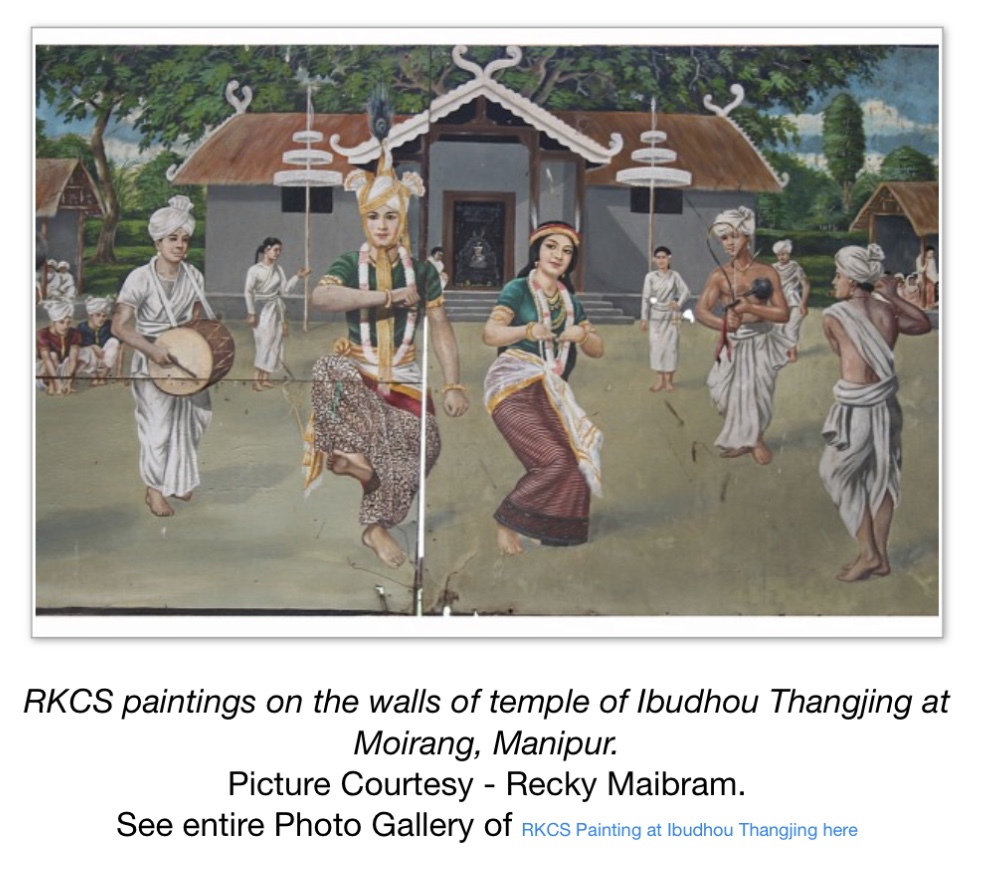
RKCS paintings on the walls of temple of Ibudhou Thangjing at Moirang, Manipur.
Picture Courtesy – Recky Maibram.
See entire Photo Gallery of RKCS Painting at Ibudhou Thangjing here
The People
The origin of the Meiteis cannot be precisely determined from the literature available. Horam[2] observed that the origin of the Meiteis is obscure (Horam 1990, 4). This has become a subject of endless debate (Tarapot 1993, 62). Kumar states that great controversies still persist regarding the origin of the Meiteis (Kumar 2001, 3). This is because most of their written records were composed after they became Hindus and therefore are not very reliable (Bhattarcharya 1963, 180; Dun 1992, 15).
Scholars differ sharply in their opinion on whether the Meiteis are Aryans or Mongoloids. There are those who claim that the Meiteis are descendants of Arjuna of Mahabharata and are therefore Aryan in origin. Others believe that they, like the tribal people, belong to the Mongoloid race. This difference is seen within the Meitei scholars themselves.
Aryan Origin
The first opinion that they belong to the Aryan origin is advocated by the Brahmins, royals, and nobles of the eighteenth century (Kumar 2001, 4). Scholars such as Iboongohal Singh, R.K. Jhalajit Singh, Atombapu Sharma, and many others believe that the Meiteis are Aryan in origin.
According to Iboongohal Singh, “The original inhabitants of Manipur were the Kiratas (some tribes of Nagas). By that time Manipur valley was full of water” (Singh 1987, 10). They were settlers in the hills. People started moving to the valley as the water slowly dried up. Iboongohal believes that it was at this time that the Aryans started coming to the Manipur valley. He writes,
But this time a group of people came headed by a Poireiton and settled here. These people from East and West came to Manipur and began to settle here, each group headed by a Poireiton. Thus Manipur became a large Aryan colony.
The present Manipuris are the descendants of those new comers who came under the leadership of those Poireitons and Mahadev and the original inhabitants. (Singh 1987, 11-12)
R.K. Jhalajit Singh writes, “a great wave of pure Aryan blood passed through the Manipur valley during the time when India and China were prosperous countries” (Singh 1992, 53). He continues to say that Manipur has always been a part of India, and that she was known to the rest of the country from ancient times, from about 300 B.C. (Singh 1992, 55). According to Kumar, the Manipur found in Mahabharata is the present Manipur state. In the story, Arjuna marries Chitrangada from Manipur and has a son from their wedlock. His name was Babhruvahana, and accordingly, the Meiteis are descendents of Babhruvahana who was the son of Arjuna of the Mahabharata (Kumar 2001, 4-5).
Though some scholars and a few influential Meiteis want to trace their origin through this tradition, it is sharply objected and challenged by many modern scho-lars. Historians and scholars such as Kabui, Horam, Thumra, Bhattarcharya, and Roy are a few to be mentioned here who reject this theory. J.H. Thumra3 writes,
“The rulers of Manipur, and a small but influential segment of the Meitei, claim that they belong to the Indo-Aryan race. They claim that they are the descendants of Arjuna of the Mahabharata, through whose wedlock with the princes Chitrangada, their son Babh-ruvahana was born in Manipur”. (Thumra 1976, 105)
Gangmumei Kabui believes that this could have been an outcome of the adoption of Hinduism by the ruling family and the people of the valley in the eighteen century (Kabui, 2003, 15). This view is supported by Kumar who says,
“The theory of the Indo-Aryan descent of Meitei was propounded by the Brahmins and supported by the royal patronage and a few sections of the people of Manipur. It was the result of the adoption of Hinduism by the ruling family and the people of valley in the eighteenth century”. (Kumar 2001, 4)
Dun argues that there is no proof whatsoever that Arjuna had a son in Manipur (Dun 1992, 16). It is also arguable that even if he had a son, the people who were living before the wedlock of Arjuna were not Aryans. In support of this, some scholars, such as B.K. & Sashi Ahluwahlia and Gait, believe that the Manipur mentioned in Mahabharata is not the present Manipur state. Gait writes,
“The Manipur mentioned in the Mahabharata was the capital of Babhruvahana, king of Kalinga. It must therefore have been situated somewhere in the south of Orissa or north of Madras (now called Chennai). Various sites in that tract have been suggested by Lassen, Oppert and others. Its exact position is still uncertain, but there can be no doubt whatsoever that it was nowhere near the place of the same name in Assam.” (Quoted from Gait by R.K. Saha 1994, 26)
According to the literature, the journey of Arjuna to Manipur by sea is yet another reason why the present Manipur state cannot be identified with that of Manipur found in Mahabharata. In no way or side is the present Manipur state connected to the sea. Kabui, quoting R.C. Majundar, writes,
As regards Manipur, its identification with the present state of Manipur has been rejected by many scholars…. Arjuna first proceeded to the Mahendra Mountains (i.e., in Eastern Ghat) in Kalinga and then proceeded to Manipur on the sea. This evidently locates Manipur on the Orissa Coast, a view taken by a number of scholars. (Kabui 2003, 5)
Other scholars such as Roy and Bhattacharya hold that from the linguistic aspect, since the structure and vocabulary of the Meitei language agrees more with the Tibeto-Burman origin, the Aryan origin is unacceptable (Roy 1973, 4; Bhattacharya 1963). T.C. Hodson and Kabui argue that such tales of Indo-Aryan ancestry are obviously tainted by the influence of Hinduism. They were believed to have been invented by the Brahmins to flatter the newly converted Meitei King and his subjects (Hodson 1908).
Kabui also points out that there is no mention made about Babhruvahana or Arjuna in the genealogies of the royal family, which was founded by Nongda Lairen Pakhangba. He says,
Manipur’s alleged Aryan connection should be viewed as an aspect of Sankritization[4] to gain respectability in the Hindu World, especially among the royal families of India, which was the normal practice of all converted ruling families either Hindus or Buddhists in North East India and South East Asia. (Kabui 1991, 3)
Another strong reason why the present state Manipur cannot be the Manipur found in Mahabharata is that it is not the ancient name of the state. According to a Manipuri historical work, the Sanamahi Laikan, “the name Manipur was first officially introduced in the early eighteenth century during the reign of Hinduised Garibniwaz (1709-48)” (Kabui 2003, 1). According to the literature, the region’s original names included Kangleipak, Sanaleipak, Kanglei Pungmayol, Poireipak, and Meitrabak (Singh 1991, 3).
Mongoloid Origin
Another tradition, which is widely accepted by scholars and writers, is that the Meiteis originated from the Mongoloid race. Historians and scholars such as Roy, Thumra, Horam, Hodson, N. Tombi Singh, and Parratt support this tradition. N. Tombi Singh, a Meitei scholar, states,
“Many … think that there is a basic difference between the valley people of Manipur (Meiteis) and those who are in hill areas. In fact it is not so. The entire people of Manipur belong to the same ethnic group and trace their origin more or less to the Sino-Tibetan group of human species.” (Singh 1972, 17)
Saroj Parratt comments, “Physically, the Meiteis are Mongoloid in appearance, which suggests that their origin should be sought further east” (Parratt 1980, 2).
Based on the Manipuri legends and historical records, V. Chakravarty (1986) concludes that the Meiteis had their ultimate origin in the hill areas of Manipur. Elwin’s description is similar when he says, “By the casual observer the so called Manipuris (Meiteis) would be pronounced a mixed race between the Kukis and the Nagas” (Elwin 1969, 451). T.C. Hodson, who was the Assistant Political Agent and Superintendent of the State of Manipur, after careful observation, remarks :
I think it is probable that when only a small part of the valley skirting the hills was capable of cultivation, the hill men bordering it used to descend and cultivate the little land there then was, returning to their homes in the hills after reaping their harvests; as, however, land increased, some few of them settled permanently in the plain, gradually increasing in numbers. The various tribes thus settling in different parts of the valley would in time come into contact, and after a struggle for supremacy, amalgamate. (Hodson 1908, 7)
Singh concludes that the Meiteis are Mongolian race. He writes, “From their general appearance they seem to be Mongolian race. Their hair is long, black and straight in most cases. … they are well built, healthy and sturdy.” (Singh 1980, 16).
There are some scholars such as Johnstone and Singh, who would argue that there is no racial purity among the Meiteis. The theory that the Meiteis originated from the Mongoloid race is the most widely accepted theory by modern scholars and writers. The younger generation among the Meiteis agree to this theory rather than the Aryan origin.
From this research, it is most accepted that the Meiteis originally belonged to the Mongoloid race. There are some instances where influential Meiteis do not want to accept this tradition.
Konghar states, “These statements (that Meiteis behaved like the tribals before they became Hindus) are not accepted by the majority of the Meiteis, especially the upper class, who always deny their alleged origin from the hill tribes” (Konghar 1996, 15). However, from the interviews, it has come to the light that many educated younger generations among the Meiteis accept the tradition that they are of the same descent with the hill tribes of Manipur.
Laishram Kumar, a respondent, says their forefathers were meat eaters, and they buried the dead. All these support the belief that the Meiteis behave like the tribals in the hills, suggesting the possible conclusion of Mongoloid origin.
Though generally accepted that they belong to the Mongoloid race, they also have some traces of Aryan features (Hodson 1908). Sir James Johnstone, who was the political agent in Manipur, writes: The Manipuris themselves are a fine stalwart race descended from an Indo-Chinese stock, with some mixture of Aryan blood, derived from the successive waves of Aryan invaders that have passed through the valley in pre-historic days. (Johnstone 1896, 97)
Jhalajit Singh believes Indo-Aryans came to Manipur and married local Mongoloid women in the first centuries of the Christian era. He is perhaps right when he says, “as a result of the fusion of Indo-Aryans and Mongoloid peoples, the nucleus of the Manipuri speaking people (Meiteis) of today was formed” (Singh 1992, 19-20). Scholars and writers, such as E. Dun (1992), Hodson (1908, 2), and M. Bhattarcharya (1963, 183) also support the tradition that the Meiteis were originally Mongoloid, a close kin with the tribal people in the hills, and were latter mixed with Aryan blood. “The mixture of blood has made the Manipuri both handsome and healthy” (Bhattarcharya 1963, 183).
It is difficult for the Meiteis to claim any racial purity due to their long stories of migration and a series of invasion by the Aryans, Shans, and Myanmars (Singh 1988, 149).
However, it is beyond doubt that they originally belonged to the Mongoloid race. Another group of Meitei people, who are the Brahmins, are believed to have come from Bengal with the coming of Hindu Vaishnavism during the seventeenth century. They are altogether a different people group, probably belonging to the Aryan race.
References:
“Kang” is a traditional indoor game played by both male and female. It is believed to have been played by deity Panthoibi.
Horam is a professor of history at Manipur University.
Jonathan H. Thumra was the principal of Eastern Theological College, Jorhat, Assam, under Serampore University.
This word should be spelled as ‘Sanskritization’.
The spelling of this word differs from one to another. Konghar has spelled this as “Ningthouchas,” but it seems more appropriate and agreeable to spell it as “Ningthouja.”
Nagas are the second largest people group in the State who live in the hills, surrounding the plain on all sides.
Lai Haraoba literally means the merry-making of the deities. It is a religious festival of the Meiteis. This will be dealt with later at length.
The Tangkhuls are a people group within the Naga community who live in the Northeastern hills of Manipur.
Jhum cultivation is also called shifting cultivation practiced only by the hill people group of Manipur State. The Meiteis, being in the valley, did not practice jhum cultivation.
The word Loi means degraded. They were so called because of their refusal to become Hindus during the reign of Pamheiba. Today they are considered as lower outcast by the Hindu Meiteis. They are the people from Awang Sekmai, Andro, Leimaram Khunou, Koutruk, Kwatha, Khurkhul, and Phayeng.
This god is also called “Atiya Maru Shidaba” which means Immortal Seed in the sky. Some called him ‘Atingkok Shidaba’. In this writing, the name Atiya Maru Shidaba has been used more frequently. This is because this is the most common name used by the people.
The Meiteis called human beings as Mee or Mee-oiba.
This very word ‘Lainingthou’ was attributed to him when the Meiteis consider him as deity. Laining-thou literally means King of the gods.
This is an oral tradition preserved by the people. It was narrated to the writer by Doren, an interviewee.
Nipamacha is a respondent of the interview.
The writer personally experienced this while he was young. His family has a very close Hindu family. Whenever the writer visited the house of the Hindu, he was not permitted inside the house. As a child he remembers sitting in the courtyard of the Hindu family.
Mipuiten
Meiteis-ho lo chhuahna hi literature awmsa atangin chiang taka hriat theih a ni lo. Horam[2] chuan Meiteis-ho lo chhuahna chu a chiang lo hle tih a hmuchhuak a (Horam 1990, 4).
Hei hi sawiselna tawp nei lo a lo ni ta a ni (Tarapot 1993, 62). Kumar chuan Meiteis-ho lo chhuahna chungchangah hian inhnialna lian tak a la awm reng tih a sawi (Kumar 2001, 3). Hei hi a chhan chu an thuziak ziah tam zawk hi Hindu an nih hnua siam a nih avangin rintlak an nih loh vang a ni (Bhattarcharya 1963, 180; Dun 1992, 15).
Mithiamte chuan Meiteis-ho hi Aryan emaw Mongoloid emaw an nih leh nih loh chungchangah an ngaihdan a inang lo hle. Meiteis-ho hi Mahabharata-a Arjuna thlah an nih avangin Aryan an ni tih sawitu an awm bawk.
Mi dangte chuan hnam mite ang bawkin Mongoloid hnam zinga mi an nih an ring bawk.
He danglamna hi Meitei mithiamte chhung ngeiah pawh hmuh tur a awm.
Aryan atanga lo chhuak
Aryan hnam chhuak an ni tih ngaihdan hmasa ber chu kum zabi sawm leh riatnaa Brahmin, lal leh mi ropuiten an sawisel a ni .
(Kumar 2001, 4).
Mithiamte zingah Iboongohal Singh, R.K. Jhalajit Singh, Atombapu Sharma, leh mi dang tam tak chuan Meiteis ho hi Aryan an nih an ring a.
Iboongohal Singh-a sawi dan chuan, “Manipur-a cheng hmasa berte chu Kiratas (Naga hnam thenkhat) an ni. Chutih lai chuan Manipur ruam chu tuiin a khat tawh a ni” (Singh 1987, 10). Tlâng lama awmte an ni. Tui chu zawi zawiin a lo vawt chhoh zel avangin ruam lam pan chuan mipui an insawn tan ta a ni. Hetih lai hian Manipur phaiah hian Aryan-ho an lo kal tan niin Iboongohal-a chuan a ring. A ziak a, .
Mahse tun ṭumah chuan mipui pawl khat chu Poireiton pakhat kaihhruaiin an lo kal a, hetah hian an lo awm ta a ni. Heng mite hi Khawchhak leh Chhim lam a\angin Manipur-ah an lo kal a, hetah hian an lo awm \an a, pawl tin hi Poireiton pakhatin an kaihruai a ni. Chutiang chuan Manipur chu Aryan colony lian tak a lo ni ta a ni.
Tuna Manipur-ho hi chu Poireiton leh Mahadev-a kaihhruaina hnuaia lo kal thar leh a awm hmasa berte thlahte an ni. (Singh 1987, 11-12) tih a ni.
R.K. Jhalajit Singh chuan, “India leh China ram hausa an nih lai khan Aryan thisen thianghlim thlipui lian tak chu Manipur ruam a paltlang a ni” (Singh 1992, 53) tiin a ziak. Manipur hi India ram chhunga awm reng a nih thu a sawi chhunzawm a, hmân lai aṭang tawhin, B.C. (Singh 1992, 55) tih a ni. Kumar sawi dan chuan Mahabharata-a Manipur hmuh chu tuna Manipur state a ni. Thuziak ah hian Arjuna hian Manipur atangin Chitrangada a nei a, an inneihna atang hian fapa a nei a. A hming chu Babhruvahana a ni a, chutiang chuan Meiteis te hi Mahabharata-a Arjuna fapa Babhruvahana thlah an ni (Kumar 2001, 4-5).
Mithiam thenkhat leh Meitei mi tlemte chuan he thurin hmang hian an bul tanna zawn chhuah duh mah se, tunlai mithiam tam tak chuan nasa takin an dodal a, an dodal bawk. Hetah hian history ziaktu leh mithiam Kabui, Horam, Thumra, Bhattarcharya, leh Roy te hi he ngaihdan hi hnawltu tlemte sawi tur an ni. J.H. Thumra3 chuan, .
“Manipur-a roreltute, leh Meitei-ho zinga mi tlemte mahse nghawng nei lian tak takte chuan Indo-Aryan hnam zinga mi an nih thu an sawi a. Mahabharata-a Arjuna thlah an nih thu an sawi a, chu chu an fapa lal fapa Chitrangada nena an inneihna kaltlangin a ni.” Babh-ruvahana hi Manipur-ah a piang a”. (Thumra 1976, 105) tih a ni.
Gangmumei Kabui chuan hei hi kum zabi sawm leh riat vela roreltu chhungkua leh ruam mipuiten Hindu sakhua an pawm atanga lo chhuak a ni thei niin a ngai (Kabui, 2003, 15). He ngaihdan hi Kumar hian a thlawp a, ani chuan,
“Meitei thlah Indo-Aryan theory hi Brahmin-hoin an rawn rawt a, lal patronage leh Manipur mipui thenkhatin an thlawp a ni. Chu chu roreltu chhungkua leh valley mipuiten Hindu sakhua an pawm avanga lo awm a ni.” kum zabi sawm leh riatnaah khan”. (Kumar 2001, 4) a ni. Mithiam thenkhat leh Meitei mi tlemte chuan he thurin hmang hian an bul tanna zawn chhuah duh mah se, tunlai mithiam tam tak chuan nasa takin an dodal a, an dodal bawk. Hetah hian history ziaktu leh mithiam Kabui, Horam, Thumra, Bhattarcharya, leh Roy te hi he ngaihdan hi hnawltu tlemte sawi tur an ni. J.H. Thumra3 chuan, .
“Manipur-a roreltute, leh Meitei-ho zinga mi tlemte mahse nghawng nei lian tak takte chuan Indo-Aryan hnam zinga mi an nih thu an sawi a. Mahabharata-a Arjuna thlah an nih thu an sawi a, chu chu an fapa lal fapa Chitrangada nena an inneihna kaltlangin a ni.” Babh-ruvahana hi Manipur-ah a piang a”. (Thumra 1976, 105) tih a ni.
Gangmumei Kabui chuan hei hi kum zabi sawm leh riat vela roreltu chhungkua leh ruam mipuiten Hindu sakhua an pawm atanga lo chhuak a ni thei niin a ngai (Kabui, 2003, 15). He ngaihdan hi Kumar hian a thlawp a, ani chuan,
“Meitei thlah Indo-Aryan theory hi Brahmin-hoin an rawn rawt a, lal patronage leh Manipur mipui thenkhatin an thlawp a ni. Chu chu roreltu chhungkua leh valley mipuiten Hindu sakhua an pawm avanga lo awm a ni.” kum zabi sawm leh riatnaah khan”. (Kumar 2001, 4) a ni.
Dun chuan Arjuna hian Manipur-ah fapa a nei tih finfiahna engmah a awm lo niin a sawi (Dun 1992, 16). Fapa nei mah se, Arjuna inneih hmaa khawsa mekte kha Aryan an ni lo tih pawh sawisel theih a ni. Chu chu thlawpin mithiam thenkhat, B.K. & Sashi Ahluwahlia leh Gait, Mahabharata-a kan sawi Manipur hi tuna Manipur state a ni lo niin an ngai. Gait chuan, .
“Mahabharata-a kan sawi Manipur hi Kalinga lal Babhruvahana khawpui a ni. Chuvangin Orissa khawthlang lam emaw, Madras hmar lam emaw (tunah chuan Chennai tia koh) hmun khatah a awm ngei ang. Chu tract-a hmun hrang hrang chu Lassen, Oppert leh midangte. A dinhmun dik tak chu hriat chian a la ni lo a, mahse Assam-a hming inang awmna hmun bulah khawiah mah a awm lo tih chu rinhlelh rual a ni lo.” (R.K. Saha 1994, 26-a Gait atanga lak chhuah)
Literature-a a lan dan chuan Arjuna-a tuipui hmanga Manipur a zin chhan hi tuna Manipur state hi Mahabharata-a Manipur state hmuh theih nen a inzawm theih loh chhan dang a ni. Engti kawng mahin leh a sir lehlamah tuna Manipur state hi tuipui nen a inzawm lo. Kabui chuan R.C. Majundar, a ziak a, .
Manipur chungchangah chuan tuna Manipur state nena a inzawmna hi mithiam tam takin an hnawl a ni…. Arjuna hian Kalinga-a Mahendra tlang (i.e., Eastern Ghat-ah) a pan hmasa a, chumi hnuah tuipui chungah Manipur-ah a kal leh ta a ni. Hei hian Manipur chu Orissa tuipui kamah a awm tih a chiang a, chu chu mithiam engemaw zatin an ngaihdan a ni. (Kabui 2003, 5) tih a ni.
Roy leh Bhattacharya te ang mithiam dangte chuan linguistic aspect atang chuan Meitei tawng structure leh vocabulary hi Tibeto-Burman origin nen a inmil zawk avangin Aryan origin hi pawm theih a ni lo niin an ngai (Roy 1973, 4; Bhattacharya 1963). T.C. Hodson leh Kabui-a te chuan hetiang Indo-Aryan thlahtute chanchin hi Hindu sakhuain a nghawng danin a tibawlhhlawh tih a chiang hle niin an sawi. Brahmin-hoin Meitei Lal piangthar thar leh a hnuaia mite chawimawina atana an siam chhuah niin an ngai (Hodson 1908).
Kabui chuan Nongda Lairen Pakhangba-a din lal chhungkaw thlahtute chanchin ziaknaah hian Babhruvahana emaw Arjuna emaw chungchang sawi a awm lo tih a tarlang bawk. Ani chuan, .
Manipur-in Aryan nena inzawmna a neih nia sawi hi Hindu Khawvelah zahawmna a neih theih nan Sankritization[4] lam hawi anga ngaih tur a ni a, a bik takin India lal chhungkua zingah chuan, chu chu India hmarchhak lama Hindu emaw Buddhist emaw pawh ni se, roreltu chhungkaw piangthar zawng zawngte tih dan pangngai a ni a, Asia chhim chhak lam. (Kabui 1991, 3) tih a ni.
Tuna kan state Manipur hi Mahabharata-a kan hmuh Manipur a nih theih loh chhan nghet tak dang chu, hmanlai state hming a nih loh vang a ni. Manipuri history work pakhat, Sanamahi Laikan-in a sawi dan chuan, “Manipur tih hming hi kum zabi sawm leh riatna tir lam khan Hinduised Garibniwaz (1709-48) lal lai khan official takin an rawn hmang tan a ni” (Kabui 2003, 1). Literature-a a lan dan chuan he bial hming hmasa berte chu Kangleipak, Sanaleipak, Kanglei Pungmayol, Poireipak, leh Meitrabak te an ni (Singh 1991, 3). Mongoloid atanga lo piang chhuak
Thurin dang, mithiam leh ziaktute pawm lar tak chu Meiteis-ho hi Mongoloid hnam atanga lo piang an ni tih hi a ni. Historian leh mithiam Roy, Thumra, Horam, Hodson, N. Tombi Singh, leh Parratt-a te chuan he thurin hi an thlawp a ni. Meitei mithiam N. Tombi Singh chuan, .
“Mi tam takin … Manipur-a valley mite (Meiteis) leh tlangram hmuna awmte inkarah hian danglamna bulpui a awm niin an ngai. A nihna takah chuan chutiang chu a ni lo. Manipur mipui zawng zawng hi hnam khata mi an ni a, an trace an ni.” origin chu Sino-Tibetan group of human species atanga lo chhuak a ni deuh ber.” (Singh 1972, 17) tih a ni.
Saroj Parratt chuan, “Tisa lamah chuan Meiteis-ho hi an hmel lan danah chuan Mongoloid an ni a, hei hian an lo chhuahna chu khawchhak lam pan zel tur a nih thu a tilang a ni” (Parratt 1980, 2).
Manipuri thawnthu leh chanchin ziakna atanga chhutin V. Chakravarty (1986) chuan Meiteis te hi an bul tanna ber chu Manipur tlangram hmunah an ni tih a sawi chhuak a. Elwin-a sawi dan pawh hi chutiang bawk chu a ni, “Casual observer-in Manipuris (Meiteis) an tihte chu Kukis leh Naga-ho inkara hnam inhmeh tak anga sawi a ni ang” (Elwin 1969, 451) a tih hi a ni. T.C. Hodson-a, Manipur State-a Assistant Political Agent leh Superintendent a nih lai khan uluk taka a enfiah hnuah heti hian a sawi :
Tlâng hual vel ruam hmun tlemte chauhvin loneih theih a nih laiin, a ramri bula tlang mite chu an chhuk a, chutih laia ram tlemte awm chu an lo ching ṭhin a, an buh seng zawh hnuah tlânga an chenna inah an kir leh ṭhin niin ka hria ; mahse, ram a lo pung chhoh zêl chuan, ṭhenkhat chu tlangram-ah chuan an awm reng a, zawi zawiin an pung chho ta a ni. Chutianga ruam hmun hrang hranga awm hnam hrang hrangte chu hun kal zelah an inzawm khawm ang a, thuneihna an beih hnuah an inzawm khawm ang. (Hodson-a chuan 1908, 7) a ziak a.
Singh chuan Meiteis te hi Mongolian hnam an ni tih a sawi chhuak a. Heti hian a ziak a, “An hmel tlangpui atang chuan Mongolian hnam ang mai an ni. An sam hi a sei a, a dum leh a dinglam a ni a, a tam zawkah chuan. … an insiam tha a, an hrisel a, an nghet bawk,” tiin a ziak. (Singh 1980, 16) tih a ni.
Johnstone leh Singh te ang mithiam thenkhat an awm a, Meiteis zingah hian hnam thianghlimna a awm lo tih an sawi ang. Meiteis-ho hi Mongoloid hnam atanga lo piang an ni tih theory hi tunlai mithiam leh ziaktute pawm lar ber a ni. Meiteis zinga thangthar zawkte chuan Aryan origin aiin he theory hi an pawm zawk a ni.
He zirchianna atang hian Meiteis te hi a tir chuan Mongoloid hnam zinga mi an ni tih hi pawm ber a ni. Meitei-ho nghawng nei lian tak takte pawhin he thurin hi an pawm duh lohna hmun ṭhenkhat a awm.
Konghar chuan, “Heng thusawi (Meiteis-te hi Hindu an nih hmaa tribal-te angin an che tih) hi Meitei tam zawk, a bik takin upper class-te chuan an pawm lo a, tlang hnam atanga lo piang nia sawi chu an hnial fo thin” (Konghar 1996, 15) a ti. . Mahse, interview-na a\ang chuan Meitei-ho zinga thalai lehkhathiam tam takin Manipur tlangram hnamte nen hian thlah khat an ni tih thurin hi an pawm tih a lo lang ta a ni.
Laishram Kumar, zawhna chhangtu chuan an pi leh pute chu sa ei thin an nih thu a sawi a, mitthite chu an phum thin niin a sawi. Chûng zawng zawng chuan Meiteis-ho chu tlânga tribal-te angin an awm tih rinna chu a thlawp a, hei hian Mongoloid origin nia thutlukna siam theih a nih thu a târ lang a ni.
Mongoloid hnam zinga mi an nih thu pawm tlangpui ni mah se, Aryan hmel lan dan engemaw zat an nei bawk (Hodson 1908). Manipur-a political agent ni thin Sir James Johnstone-a chuan heti hian a ziak a: Manipur-ho ngei pawh hi Indo-Chinese stock atanga lo piang hnam nghet tak tak an ni a, Aryan thisen inzawmkhawm engemaw zat an nei a, Aryan invader-te thlipui inzawmkhawm atanga lo chhuak an ni valley chu pre-historic hunlai khan a ni. (Johnstone-a chuan 1896, 97) a ziak a.
Jhalajit Singh chuan Indo-Aryan-te chu Manipur-ah an lo kal a, Kristian hunlai kum zabi hmasa berah khan tualchhung Mongoloid hmeichhiate an nei niin a ngai. “Indo-Aryan leh Mongoloid hnamte inzawmkhawmna avang hian tunlai Manipuri tawng hmang mi (Meiteis) te nucleus chu a lo piang ta a ni” (Singh 1992, 19-20) a tih hi a dik mai thei. Mithiam leh ziaktute, E. Dun (1992), Hodson (1908, 2), leh M. Bhattarcharya (1963, 183) te pawhin Meiteis-ho hi a tir chuan Mongoloid an ni a, tlangram hnamte nena inzawmna nei tak an ni tih thurin hi an thlawp bawk , leh a hnuah Aryan thisen nen an inhmeh ta a ni. “Thisen inzawmkhawm hian Manipuri chu a hmeltha a, a hrisel bawk” (Bhattarcharya 1963, 183).
Meiteis-ho tan chuan hnam thianghlimna engmah sawi a harsa hle a, an pem dan chanchin rei tak tak leh Aryan, Shan leh Myanmar-ho rawn beih dan hrang hrang avang hian (Singh 1988, 149).
Mahse, a tir chuan Mongoloid hnam zinga mi an ni tih chu rinhlelh rual a ni lo. Meitei mi pawl dang, Brahmin-ho chu kum zabi sawm leh pasarihna lai vela Hindu Vaishnavism lo chhuahna nen Bengal atanga lo kal an nih rin a ni.
An vai hian mipui pawl danglam tak an ni a, Aryan hnam zinga mi an ni ngei ang.
Thuhmahruai:
“Kang” hi indoor game hlui tak a ni a, mipa leh hmeichhia te pawhin an khelh thin a ni. Pathian Panthoibi-a khelh nia rin a ni.
Horam hi Manipur University-ah history professor a ni a, a hnathawhna hmunah hian a hlawhtling hle.
Jonathan H.
Thumra hi Serampore University hnuaia Eastern Theological College, Jorhat, Assam-ah principal a ni a.
He thumal hi ‘Sanskritization’ tia ziah tur a ni.
He thumal spelling hi a inang lo hle. Konghar hian hei hi “Ningthouchas” tiin a spell a, mahse “Ningthouja” tia spell hi a dik zawkin a remti zawkin a lang.
Naga hi State chhunga mipui pawl lian ber pahnihna an ni a, tlanga cheng an ni a, a sir zawng zawngah tlangram hi an hual vel a ni.
Lai Haraoba tih awmzia tak chu pathiante hlim taka siam tihna a ni. Meiteis-ho sakhua kût a ni. Hei hi a hnuah thui takin kan sawiho ang.
Tangkhul-ho hi Naga community chhunga mipui pawl, Manipur hmarchhak tlangdunga cheng an ni.
Jhum chin hi shifting cultivation an ti bawk a, Manipur State-a hill people group-te chauhin an tih thin a ni. Meiteis-ho chuan ruamah an awm avangin jhum chin an hmang lo.
Loi tih thumal hian degraded tihna a ni.
Pamheiba lal laia Hindu an nih duh loh vangin chutianga koh an ni.
Tunah chuan Hindu Meiteis-te chuan lower outcast-ah an ngai ta a ni.
Awang Sekmai, Andro, Leimaram Khunou, Koutruk, Kwatha, Khurkhul, Phayeng atanga lo kalte an ni.
He pathian hi “Atiya Maru Shidaba” an ti bawk a, chu chu vanah Thlai Thi thei lo tihna a ni.
Ṭhenkhat chuan ‘Atingkok Shidaba’ an ti a. He thuziak ah hian Atiya Maru Shidaba tih hming hi hman a ni tawh zawk.
Hei hi mipuiin an hman tlanglawn ber a nih vang a ni.
Meiteis-ho chuan mihringte chu Mee emaw Mee-oiba emaw tiin an ko thin.
He thumal ‘Lainingthou’ tih hi Meiteis-hoin pathian anga an ngaih lai khan a sawina a ni. Laining-thou tih awmzia tak chu pathiante Lal tihna a ni.
Hei hi mipuiin an humhalh (oral tradition) a ni. A ziaktu hnenah hian interview-naa tel Doren-i’n a sawi a ni.
Nipamacha hi interview-a chhangtu a ni.
He thu hi ziaktu hian a naupan laiin a mimal takin a tawng a ni.
A chhungte hian Hindu chhungkua hnai tak an nei a. A ziaktu hian Hindu in a tlawh apiangin in chhungah a luh phalsak a ni lo.
Naupang a nih laiin Hindu chhungkaw huangah a thut thu a hrechhuak.

 𝐍𝐆𝐀𝐖𝐍 𝐂𝐇𝐈𝐍 𝐇𝐈𝐒𝐓𝐎𝐑𝐘