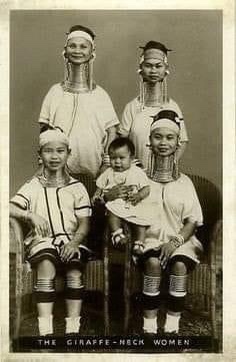
Salwin Sittaung and the Irrawaddy River in the 9th century AD from the lower reaches of the Yangtze River in China. In the east of the They have gradually moved to the mountains of Shan Roma and have been living steadily. The Kayan ethnic group does not move in groups like other mountain ethnic groups. From ancient times until today, the Kayan ethnic group has lived in Mobre Mountain and Phegon Township west of In, Biking, Sisu, Sinaite, Lai area, Dee Mosso Township, Loikaw Township, They have always lived on the great Shan Roma Mountains between the Ping Laung border and the Ping Mana Plain. Kayan Karen Kayah Gemo, Gebara This friend Instead, The ethnic groups in between are descended from the same ethnic group.
The beauty of the beauty of Kayan Yumei’s dress, which is famous in the world.
Kayan women’s clothing remains a wonder in the middle of the world. their necks, It is a common knowledge that the body parts from the wrists to the elbows and from the ankles to the knees are wrapped and decorated with bronze rings. If you weigh the copper plates on the whole body, the total weight is no less than 60 pounds (about 17 pounds). It is very surprising and commendable that women can carry that weight in their bodies and carry out their eternal duties. Therefore, they are considered as the world’s wonder women around the world. Today’s young Kayan women don’t wear brass rings, tying knots according to the times. However, most of them maintain their culture and customs without losing them. By preserving the traditional culture. Because of the encouragement of the parents, It can be seen that the practice of wearing bronze rings is still being made.
Kayan women start to wrap around the gong from the age of 5, and when they start tying, they wrap 2 to 3 gongs, and when they are over 10 years old, they remove the 3 or 4 gongs that their five-year-old daughter used to wrap and wrap up to 10. If you are over 20 years old, you will go around again from fifteen to twenty years old. To stabilize the copper coils wrapped around the neck, there are copper coils wrapped separately on both shoulders below the neck. The copper rings wrapped around the necks of Kayan women are not wrapped in a single ring, but a length of copper rod is wound like a coil. The size of the bronze medal is slightly smaller than the size of a woman’s pinky finger. Kayan women wear not only copper necklaces but also silver plates around their necks. Loafers Coins are drawn together and decorated. Even if you take off the copper plates, the neck will not budge. In the past, it was thought that the neck would be a little narrower and longer, but when the X-ray was taken, that idea was invalidated. The reason is that the neck is not elongated because of the brass ring, but because of the weight of the brass ring on the neck, the collarbone ribs and spine are bent downwards.
To this day, there is no specific evidence as to why the Kayan women wear bronze bracelets. Although they have not been able to find out yet, I will express some of the opinions handed down by the elders and the young.
It is said that they are tied to bronze rings and weights so that they cannot escape from one ethnic group to another.
The Kayans are believed to be descended from the dragon race, so they wrap themselves in bronze to look like a dragon.
Unmarried, unmarried immature It is also good that you can identify it by looking at the copper wrapping.
-In ancient times, when one group of people fought against another, the winner captured the loser and wrapped them in bronze to prevent them from escaping.
When Kayan women travel in the deep forest, to avoid the attack of wild animals.
The Kayans used to mine gold. gold and silver with silver mines, Because they were rich in jewels, the soft golden rod, They used to wear gold and silver with silver sticks, and when gold and silver were scarce, they changed to bronze.
The Kayans once visited the Shwedagon Pagoda, but there is no specific historical record other than the opinion that they wrapped their necks around the pagoda due to the abundance of gold and silver jewels in their area.
Until now, many people have been interested in whether the health of Kayan women can be affected by wearing a copper necklace around the neck. If we have to give answers to the questions of whether it can shorten the life span or hinder the growth of the population, then we must know that it does not cause any harm. In addition, it is also known that the beauty painting of bronze rings is not particularly harmful to health. In any case, every nation Every nation has its own beauty. Women are the ones who want to be more beautiful than the beauty provided by nature. Women are different from each other in creating and painting to make themselves beautiful. They want to innovate with their own ideas and tools that are close at hand. In accordance with the place of residence and the ethnic culture, the appropriate dress and dress and knots are different, each school, each village, each mantra has been recorded in an endless way. It can be said that the beauty of the Kayan women in Myanmar is unique among the women who decorate themselves in such a unique and sophisticated way.
Not only the population in Myanmar is small, but the Kayan women, who are not well known, are beautiful and mysterious, and will never be forgotten.
Chapter nine. . An article by Khunni Kolas, a columnist from the Union Ethnic Development Institute 1989-90 magazine commemorating the 7th anniversary of silver, is quoted.
Kayan people
Contact
Khamee Media Group
KMG ✅.
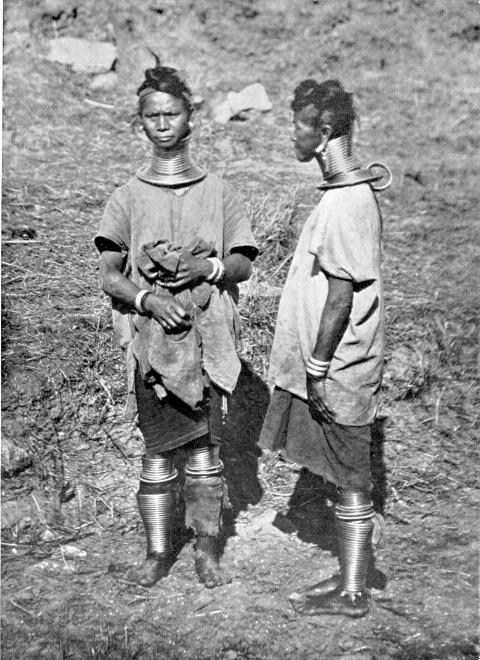
Women of the Kayan tribes( Myanmar (Burma)) identify themselves by their forms of dress. Women of the Kayan Lahwi tribe are well known for wearing neck rings, brass coils that are placed around the neck, appearing to lengthen it. The women wearing these coils are known as “giraffe women” to tourists and Padaung (Yan Pa Doung) is a Shan term for the Kayan Lahwi. Girls first start to wear rings when they are around 5 years old. Over the years the coil is replaced by a longer one and more turns are added.
The weight of the brass pushes the collar bone down and compresses the rib cage.
The neck itself is not lengthened; the appearance of a stretched neck is created by the deformation of the clavicle.
Many ideas regarding why the coils are worn have been suggested, often formed by visiting anthropologists, who have hypothesized that the rings protected women from becoming slaves by making them less attractive to other tribes. It has also been theorised that the coils originate from the desire to look more attractive by exaggerating sexual dimorphism, as women have more slender necks than men. It has also been suggested that the coils give the women resemblance to a dragon, an important figure in Kayan folklore.The coils might be meant to protect from tiger bites, perhaps literally, but probably symbolically.
Kayan women, when asked, acknowledge these ideas, and often say that their purpose for wearing the rings is cultural identity (one associated with beauty).
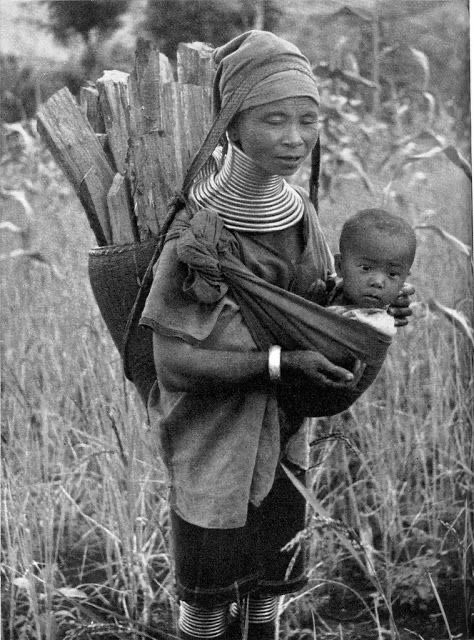
The government of Myanmar began discouraging neck rings as it struggled to appear more modern to the developed world. Consequently, many women in Myanmar began breaking the tradition, though a few older women and some of the younger girls in remote villages continued to wear rings. In Thailand the practice has gained popularity in recent years because it draws tourists who bring revenue to the tribe and to the local businessmen who run the villages and collect an entry fee of 250 baht per person. The Karenni National People’s Liberation Front (KNPLF), an armed cease-fire group, have made attempts to invite the Kayan to return to Kayah State to set up their own tourist villages
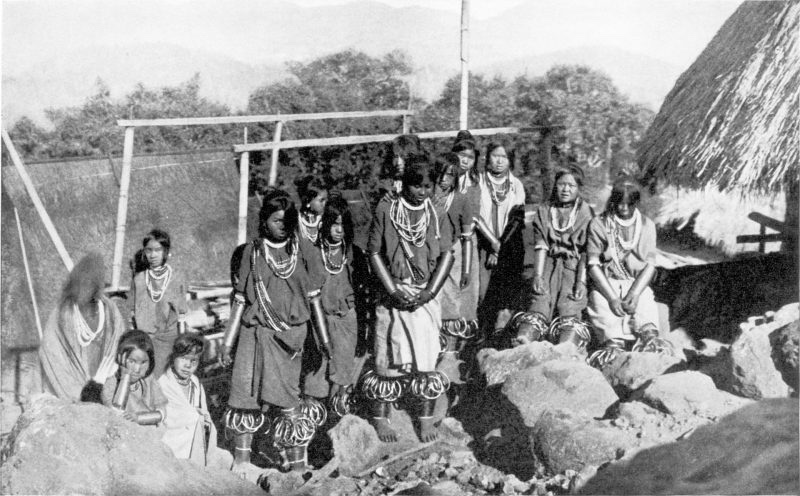

 𝐍𝐆𝐀𝐖𝐍 𝐂𝐇𝐈𝐍 𝐇𝐈𝐒𝐓𝐎𝐑𝐘